
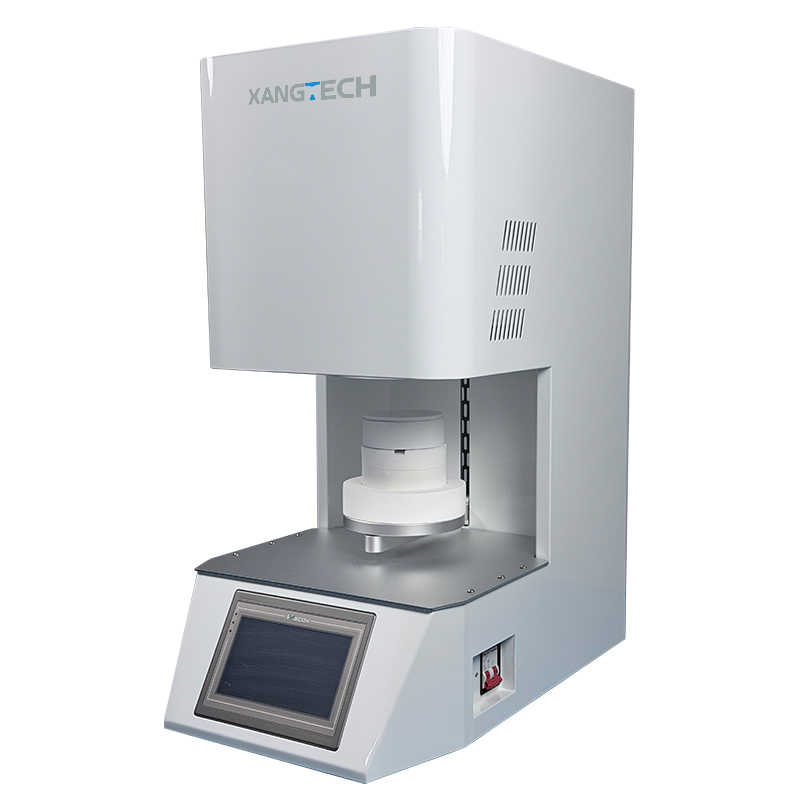
Zirconia is hardly a novelty in the field of dental restoration. Thanks to its exceptional strength, excellent biocompatibility, and translucency that increasingly mimics natural teeth, zirconia has become a mainstream choice for fabricating dental crowns, bridges, and implant superstructures. However, a crucial fact is often overlooked: the final quality of a zirconia restoration depends not only on the material itself but, more importantly, on the final sintering process. Factors such as the strength, translucency, and dimensional accuracy of a zirconia crown are largely determined inside the sintering furnace. XANGTECH 12S dental zirconia sintering furnace was designed with this context in mind. Its objective is clear: to provide dental laboratories and clinics with a furnace that offers fast, stable sintering performance and long-term durability.
1. Heating System: Balancing Efficiency and Precision
Let’s begin with the heating system. XANGTECH 12S utilizes high-quality domestic molybdenum disilicide (MoSi2) heating elements. These elements are characterized by their high-temperature resistance and oxidation resistance; they operate stably over extended periods without rapid degradation within the 1400°C to 1600°C range—the most common temperature zone for zirconia sintering. Compared to the alloy resistance wires found in older models, MoSi2 elements experience a slower decline in power output over time and offer a longer service life. Although the initial investment is higher, the cost-per-firing is actually more economical in the long run.
The most practical feature of this device’s heating system is its dual heating mode capability. The first is a rapid heating mode designed for high-volume, routine zirconia production; it offers fast heating rates and short sintering cycles, allowing for more firing batches per day—a tangible benefit for laboratories prioritizing productivity. The second is a slow heating mode, which provides a more gradual temperature rise specifically tailored for high-translucency, multi-layered zirconia materials. These materials are sensitive to temperature fluctuations; if the heating rate is too rapid, crystal phase transformation may be incomplete, resulting in compromised translucency and a failure to achieve the desired color gradation in the finished crown. A slow heating rate allows for more complete crystalline phase transformation and thorough stress relief within the material, resulting in a finished restoration with superior aesthetic qualities. The availability of both modes means that dental laboratories do not need to compromise their choice of materials to accommodate equipment heating limitations; suitable sintering curves can be found for zirconia from various brands.
2. Lifting Mechanism and Chamber: Balancing Precision and Safety
The positional accuracy of the sintering platform during each ascent and descent directly affects the uniformity of the temperature distribution inside the furnace chamber. If the platform stops at varying positions, the relative height of the dental crowns within the chamber changes, altering the thermal radiation conditions and potentially leading to temperature variances among products in the same batch. The XANGTECH 12S zirconia sintering furnace employs a lifting system combining a high-precision ball screw with linear guide rails. This transmission method is well-established in industrial equipment, characterized by high efficiency, precise positioning, and negligible backlash. Simply put, the platform stops accurately every time, without fluctuating in height. Guided by the linear rails, the platform does not wobble laterally during movement, ensuring long-term mechanical precision.
Next, consider the furnace’s sealing structure. It utilizes a fully enclosed heating chamber, meaning the high-temperature zone is completely encapsulated within a sealed space formed by the furnace body and the insulation layer. This design offers multiple benefits. First is safety: while internal temperatures exceed 1,000°C, the insulation layer isolates the outer casing, protecting operators from burns during loading and unloading. Second is energy efficiency: the enclosed chamber minimizes heat loss, requiring less power to maintain the temperature. Third is thermal uniformity: the enclosed structure prevents interference from external airflow, resulting in more stable heat distribution inside the chamber. Fourth is heating element protection: the enclosure reduces the exposure of the molybdenum disilicide (MoSi2) heating elements to oxygen and water vapor in the ambient air, thereby extending their service life.
3. Safety Protection: Relying on Redundancy, Not Luck
As a high-temperature device, the sintering furnace demands the utmost attention to safety. Significant effort has been invested in this area, integrating multiple independent protection mechanisms.
High-temperature protection serves as the first line of defense. In addition to the primary temperature control system, the equipment features an independent over-temperature monitoring channel, creating a redundant setup. Should the main temperature controller or thermocouple malfunction—causing a temperature signal drift—the independent monitoring channel can still detect the risk of overheating. It then cuts off the heating power supply directly via a hardware relay, rather than relying on software-based judgment. This hardware-level redundancy design minimizes the risk of thermal runaway.
Overcurrent protection addresses abnormal current within the heating circuit. In the event of molybdenum disilicide (MoSi2) heating element aging or a circuit short-circuit—causing a sudden surge in current—the protection device immediately cuts off power once the preset threshold is exceeded, thereby preventing damage to the heating elements and internal wiring.
Another crucial yet often overlooked safeguard is fan failure protection. During operation, cooling fans dissipate heat from the furnace body and electrical cabinet; if a fan stops spinning—due to a burnt-out motor or a seized bearing—heat cannot escape, potentially leading to overheating and damage to electrical components. The equipment features an internal rotational speed monitoring module; if an abnormal fan speed is detected, the system automatically halts the heating process and cuts the power supply.
Additionally, the equipment is equipped with an audible alarm; whenever any protection mechanism is triggered, an alert sounds to notify the operator. This multi-layered protection system ensures that the equipment can shut down safely in the event of an anomaly, rather than continuing to operate under faulty conditions.
4. Furnace Capacity: High volume, uniform firing
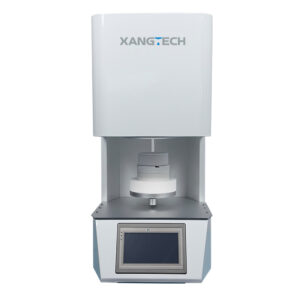
The XANGTECH 12S features an effective furnace chamber size of 130 mm in width and 125 mm in height. These dimensions were determined based on the typical size of dental restorations and the daily loading requirements of dental laboratories. The width easily accommodates standard crown trays, while the height allows for multi-layer loading, maximizing space utilization. Compared to previous models, the furnace capacity has been increased, allowing for a higher number of crowns to be fired in a single batch. For high-volume laboratories, this reduces the number of firing cycles required daily, thereby saving time otherwise spent on loading, unloading, and initiating programs.
Increased capacity is beneficial, but only if the temperature field remains uniform. If the chamber is enlarged but temperatures vary across different locations, the fired crowns may exhibit inconsistencies in size and color within the same batch. It addresses this issue through careful design; the thickness and density of insulation materials, the arrangement of heating elements, and the placement of thermocouples have all been optimized to ensure temperature uniformity. Test data indicates that under normal loading conditions, temperature deviations across different locations within the chamber are kept within acceptable limits. Consequently, crowns in the same batch maintain excellent consistency regarding shrinkage, translucency, and strength, leading to lower rework rates.
5. User Interface and Data Management: User-friendly and traceable
XANGTECH 12S is equipped with a 7-inch color touchscreen. The screen features a hardened finish that is scratch-resistant and impervious to chemical agents, making it reliable for use in a dental laboratory environment. Touch sensitivity has been calibrated to accommodate operators wearing gloves, ensuring smooth operation even with medical protective gloves.
The main interface displays all critical operational information at a glance—including current temperature, operating stage, sintering curve ID, remaining time, platform position, and system self-check status—eliminating the need to navigate through menus. The device comes pre-loaded with program templates for both rapid and slow sintering, making them easy to access. It also allows authorized operators to customize parameters—such as heating rate, holding temperature, holding time, and cooling rate—to align with the recommended processing specifications of various material brands.
Regarding data management, the device stores a full year’s worth of historical sintering curves. During each sintering cycle, the system records temperature data points at fixed intervals and associates them with information such as the operation date, start time, program number, and operator ID. Operators can retrieve historical curves by date or batch for superimposed comparative analysis. This feature is highly practical in real-world production: quality managers can use it to verify the consistency of temperature control across different batches; if an issue arises with a specific batch of crowns, technicians can recall the corresponding sintering curve to check for abnormal fluctuations during the heating, holding, or cooling phases and quickly identify the cause; additionally, process engineers can continuously optimize workflows by comparing curves generated under different parameter settings against the resulting product quality.
6. Multilingual Interface: Designed for the Global Market
XANGTECH 12S sintering oven operating interface supports eight built-in languages—Chinese, English, Spanish, Russian, German, French, Italian, and Romanian—covering major global markets for dental equipment. For export purposes, operators can switch the interface to their native language, enabling them to accurately understand parameters without relying on translations or requiring additional training. From an operational risk perspective, interface localization also minimizes the likelihood of errors caused by language misunderstandings, making it easier for multinational dental laboratory groups to standardize operating procedures across their branches in different countries.
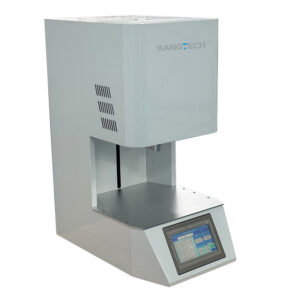
In summary, the technical value of XANGTECH 12S dental sintering furnace lies not in the superiority of any single feature, but in its systematic engineering approach to every aspect of the precision zirconia sintering process—ranging from thermal field generation, mechanical drive systems, and safety monitoring to user interaction and data management—delivering a balanced and reliable technical solution.
Overall,it is a professional-grade unit systematically designed to meet the practical demands of dental zirconia sintering. It prioritizes the dimensional accuracy, mechanical strength, and aesthetic quality of every batch of restorations while simultaneously ensuring ease of use and safety for operators. It supports immediate production needs while leaving ample technical scope for long-term quality traceability and process optimization. For dental laboratories, denture processing centers, and research or educational institutions striving for process stability, production efficiency, and high standards of quality management, it offers more than just a well-balanced sintering system; it provides a reliable assurance that spans the equipment’s entire lifecycle. This is precisely why it continues to garner sustained attention and professional recognition among similar products.


