
In contemporary restorative clinical practice, an increasingly unavoidable reality is that patients’ aesthetic expectations for restorations have long surpassed the basic thresholds of “usability” and “durability,” leaping directly to the ultimate demand of “indistinguishability from natural teeth.” However, most traditional restorative materials remain plagued by a fundamental physical bottleneck—they are mostly optically homogeneous single-layer structures, unable to replicate the continuous, lifelike optical layers of natural teeth from the incisal edge to the neck within a single restoration. This problem is particularly critical in the anterior teeth region, as they are precisely at the visual center of a smile, adjacent to natural teeth, and constantly exposed to various light sources—morning sunlight, the warm hues of dusk, the cool white lighting of the clinic, even the faint blue light from a phone screen—any slight deviation in brightness or light transmission will be keenly perceived by patients. Even if they cannot describe this discomfort in professional terms, they will subconsciously label the restoration as “unnatural.”
The root of the problem lies in the fact that natural teeth are not, in essence, a homogeneous mineral material, but a delicate, multi-layered optical system. Tooth enamel and dentin differ significantly in chemical composition, crystal arrangement, and density distribution. When light passes through teeth, it undergoes a complex interaction of refraction, scattering, absorption, and transmission, ultimately presenting a unique visual characteristic that combines clear, sharp edges with a warm, substantial feel. While traditional zirconia ceramic blocks have seen continuous improvements in translucency, their single-layer homogeneous structure limits them to a choice between “high translucency” and “occlusiveness,” failing to replicate the natural tooth’s translucent incisal edge and full, gradual transition at the cervical margin. This is the fundamental reason why many restorations appear perfect under a color-matching lamp but appear flat, lifeless, or even exhibit a brightness discontinuity with adjacent teeth at certain angles.
To address this issue, traditional techniques rely on complex manual staining and layering to artificially create the illusion of color depth on a single-layer ceramic block. This requires personal experience, repeatedly adjusting the concentration of the staining solution, estimating penetration time, and controlling brushing pressure, attempting to artificially create a color change from the cervical margin to the incisal edge on the ceramic block surface through external force. However, each step of the manual process involves uncontrollable variables: the penetration depth of the staining solution varies on different porcelain blanks; subtle fluctuations in the temperature field within the sintering furnace can alter the color development of metal ions in the dye; and even the same formula may not remain completely consistent across different batches of dye. From a probabilistic perspective, each additional manual step exponentially amplifies the likelihood of the final product deviating from the expected outcome. Clinically, the most direct consequence of this uncertainty is the discovery of visually discernible differences between the restoration and the colorimetric record during trial fittings, or patients complaining of a “dull” or “grayish” color, necessitating rework and redoing. This wastes materials and time, and severely erodes the patient’s patience and trust in the treatment team. Even more worrying is that due to the mismatch in thermal expansion coefficients between the manually stained layer and the base material, microscopic peeling or edge fading may occur years later under the moist environment of the oral cavity and the effects of long-term chewing forces—this delayed aesthetic defect is a clinical risk that restorative dentists seeking long-term therapeutic effects absolutely do not want to accept.
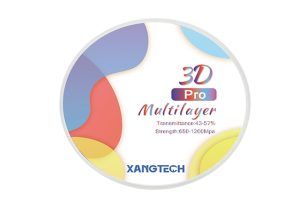
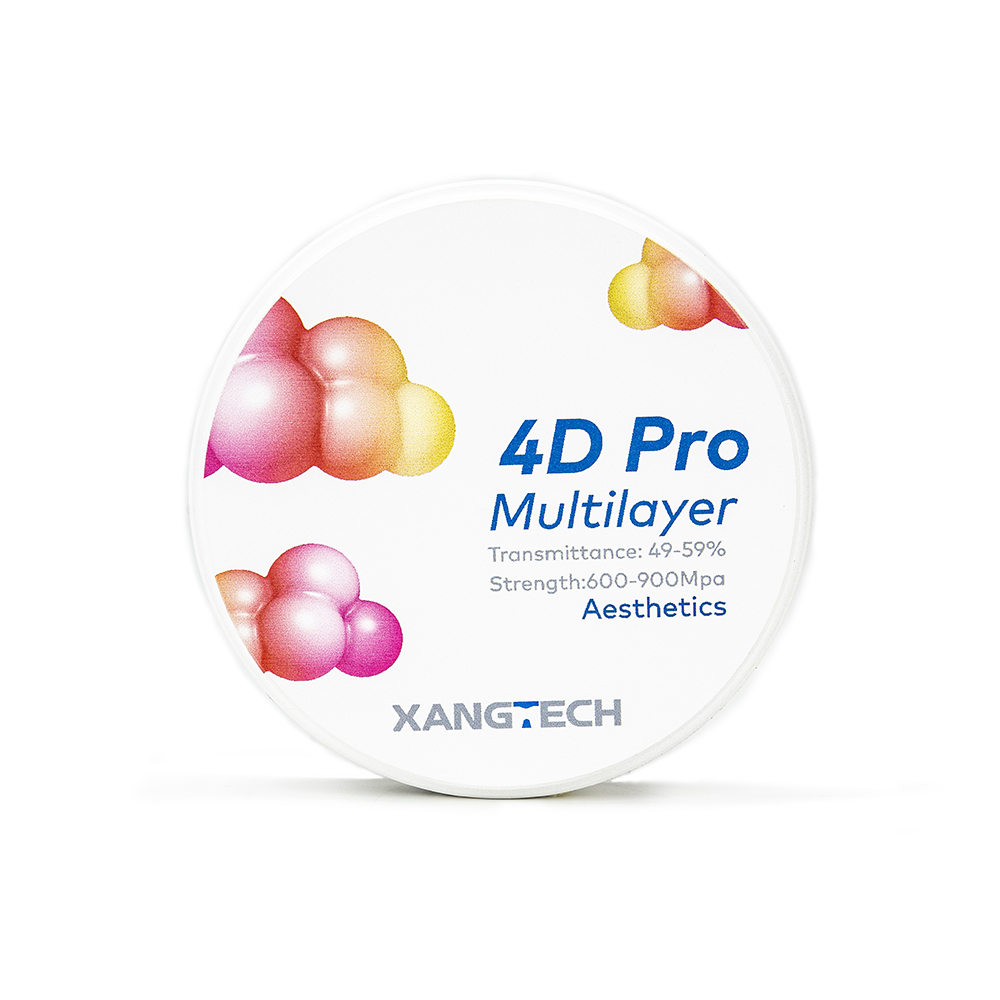
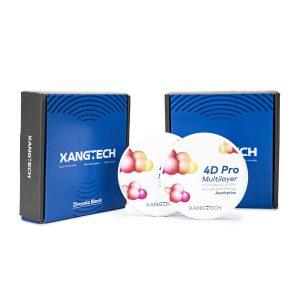
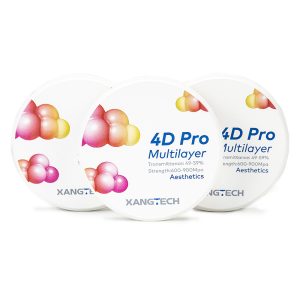
Faced with the dual challenges of the optical limitations of materials and the uncontrollability of manual craftsmanship, XANGTECH 4D Pro Aesthetic Multilayer Zirconia Block offers a completely new solution. Its core idea, though simple, is profoundly insightful: to pre-build all the aesthetic attributes of the restoration—including color depth, light transmission gradient, and light and shadow gradation—into the material’s inherent structure during the block’s fabrication stage, rather than leaving it to the technician to manually adjust later. Specifically, this porcelain block integrates five layers of light transmission control structure and nine layers of color gradient structure, working synergistically in the vertical direction. These five layers precisely control the transmission path of light through the restoration, setting the light transmittance at 49% in the incisal edge area and 59% in the cervical area. This seemingly small 10% difference actually stems from precise measurements of the optical characteristics of numerous natural teeth—the incisal edge of natural teeth is composed of a thicker enamel layer, resulting in better light transmittance, while the cervical area, due to the thicker dentin layer and enhanced scattering, naturally exhibits lower light transmittance and richer color saturation. The nine-layer gradient structure builds upon this foundation with a more refined color flow network. By controlling the concentration variations of pigment ions and the gradual distribution of grain size, a seamless, continuous color band is formed at the microscopic scale: the incisal edge exhibits the clear, translucent texture characteristic of enamel, the warm undertone of dentin gradually emerges in the center, and the cervical region displays a full and subdued color. The entire transition is natural and coherent, entirely determined by the material’s own structure, requiring no manual staining intervention.
The clinical advantages of this design are evident and directly address several core concerns of doctors and patients. Firstly, there is the realism and stability of the color. Because the optical gradient is solidified within the material, the restoration’s appearance under different ambient light sources no longer fluctuates as with traditional materials—it won’t appear bluish under surgical lights, yellowish under warm light, or whitish under outdoor light. Regardless of changes in light source, the restoration maintains synchronized color shifts with adjacent teeth, remaining consistently harmonious. This stability under multiple light sources is crucial for anterior aesthetic restorations because patients’ daily lives involve far more than just the color-matching lights in the clinic; they experience countless complex changes from indoors to outdoors, from day to night, and from natural to artificial light.
Secondly, there’s the improvement in visual texture. Traditional high-transparency zirconia often pursues extremely high transparency, resulting in a glaring specular reflection on the restoration surface that stands out starkly in a crowd. In contrast, our 4D Pro ceramic blocks, due to the diffuse scattering effect of their multiple internal interfaces, exhibit a soft, warm halo effect on the surface, closely resembling the luster and texture of natural tooth enamel. This visual “step back” allows the restoration to blend naturally into the entire dental arch, rather than becoming a glaring focal point in the smile—this “invisible restoration” is the ultimate goal of anterior aesthetics.
Looking at the technician’s workflow, the changes brought about by this material are equally profound. Technicians no longer need to go through a series of manual procedures that rely on experience and feel, such as mixing dyes, estimating penetration time, and controlling brushing pressure. They only need to follow standard procedures for cutting and sintering to directly obtain a semi-finished restoration with complete color depth and light and shadow gradation. Subsequent polishing and glazing operations are only to release the material’s inherent gloss potential, rather than creating new color variables. This means that restorations made by different operators, in different batches, and at different times can all exhibit color performance within an extremely stable range, fundamentally ensuring the repeatability of quality. For chain restoration centers or large-scale digital processing platforms, this means that quality control can shift from relying on the individual technician’s ability to relying on the stability of the material itself and the precision of the equipment, completely simplifying the management logic.
Finally, from the perspective of long-term efficacy, because the color elements are evenly distributed within the material matrix rather than attached to the surface, there is no physical path of interface peeling or staining layer degradation. After years of functional load in the oral environment, the restoration can still maintain its initial color at the time of manufacture, without delayed degradation such as neck fading or incisional edge discoloration. This undoubtedly provides a crucial safety net for clinical protocols that aim for a restoration’s lifespan of over ten years.
In conclusion,XANGTECH 4D Pro aesthetic multilayer zirconia block represents more than just the advent of a new material; it signifies a fundamental shift in aesthetic restoration philosophy—transferring the power to determine the aesthetics of a restoration from the technician’s personal experience and craftsmanship to the inherent certainty and repeatability of materials science. This transformation means that high-quality aesthetic restorations no longer depend on the occasional brilliance of a few master technicians, but become a predictable outcome that any team operating according to established procedures can consistently produce. For restoration physicians and technicians who pursue excellent therapeutic effects while valuing efficiency and stability, this is undoubtedly a path of advancement worthy of serious consideration.
In the field of aesthetic dental restorations, the true measure of a brand’s value is never the quantity of materials or the accumulation of technical jargon, but rather its ability to genuinely address every real pain point in clinical practice. XANGTECH consistently focuses its R&D efforts on the continuous analysis of the optical nature of natural teeth, and based on this, provides dentists and technicians with highly predictable material solutions. We understand that every color matching in the clinic, every cut on the lab bench, and every fitting in the patient’s mouth should not be hampered by uncertain variables—the color depth, translucency, and long-term stability of the restoration should be guaranteed by the material’s own structure, not by the improvisation of individual operators. Therefore, XANGTECH insists on pre-embedding complex optical gradients and color distributions into the materials, allowing subsequent processing to return to its simplest and most controllable state. This approach of simplifying the process from the source and locking in quality through structure ultimately points to a clear goal: enabling dentists to develop treatment plans more confidently, enabling technicians to complete fabrication tasks more efficiently, and ensuring that patients, when wearing the restoration, feel not the presence of a foreign object, but a natural continuation of their own smile. XANGTECH, with its solid materials science, responds to the full clinical expectation for aesthetic certainty in dental restorations.


