
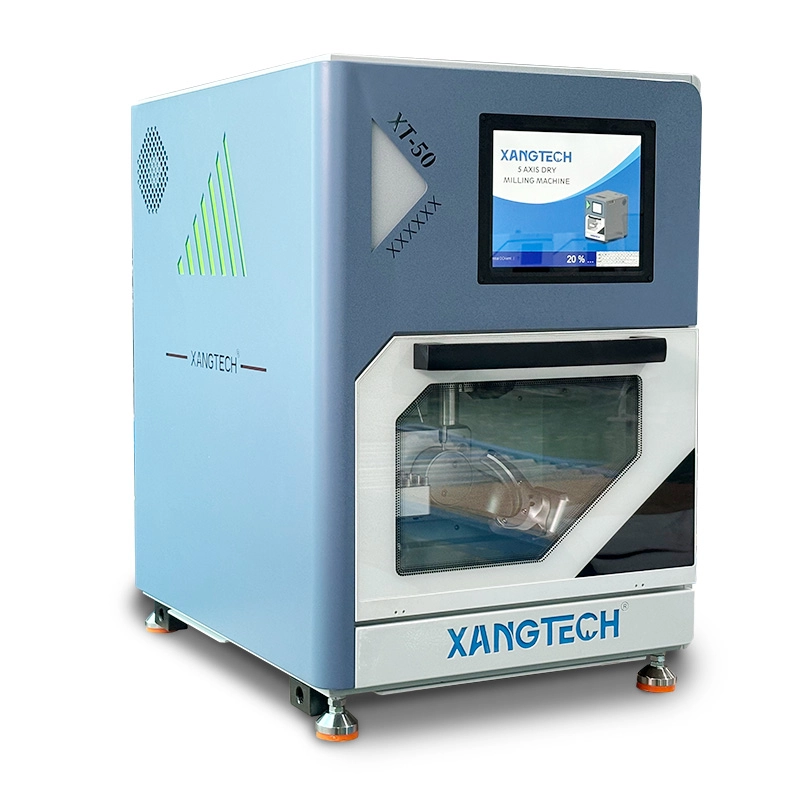
In the field of precision dental restoration, the tolerance for error has long been compressed to the micrometer level—a step deviation at the edge of a single anterior tooth restoration can lead to years of malocclusion discomfort for a patient; and a minute-level delay in a single cutting process is enough to disrupt the appointment schedule of an entire clinic for the next few weeks. While mainstream industry competition is still focused on the arms race of spindle speed and the stacking of the number of axes, the birth of XANGTECH XT-50 five-axis dental dry milling machine presents a completely different technological philosophy: it does not attract attention with flashy numbers in the parameter table, but redefines the technological boundaries of “dry milling,” a technology that has long been regarded as a compromise process, with almost demanding engineering restraint—completely stripping it of its old image of dust, frequent thermal deformation, and compromised precision, and forging it into a precision manufacturing paradigm that achieves a dynamic balance between precision and efficiency. The advent of this device did not stem from a gradual repair of existing products, but rather from a fundamentally forward-looking question posed by dental technicians: Now that zirconia has become the primary restorative material, can we build a machine from scratch that simultaneously eliminates the three core obstacles that have long plagued dry machining: dust dispersion, structural vibration, and thermal drift? The XANGTECH XT-50 dental milling machine’s systematic answer to this question lies precisely in the micro-engineering details that cannot be quantified in any product manual.
From the moment the operator enters the control area, XT-50 zirconia milling machine conveys a clear message through its underlying architectural design philosophy. The use of aerospace-grade aluminum for its main structure is not merely for simple weight reduction, but rather based on precise modeling and rigorous verification of inertial mechanics and thermal dynamics. While traditional cast iron milling machines are known for their high damping characteristics, effectively attenuating cutting vibrations, their enormous heat capacity becomes a hidden drawback in dry cutting environments. The periodic start-stop cycles of the workshop’s air conditioning system cause ambient temperature fluctuations, sufficient to induce slow and continuous thermal deformation in the cast iron frame. This micron-level geometric drift accumulates over several hours of continuous machining, ultimately manifesting as a systematic deviation in the placement path and adjacent relationships of the repaired part. In contrast, aerospace-grade aluminum, while ensuring that bending stiffness and modal frequencies meet stringent requirements, significantly reduces the structure’s thermal time constant. This allows the equipment to approach thermal equilibrium very quickly after a cold start, and this equilibrium point remains highly stable within the typical temperature fluctuation range of a workshop. It is worth emphasizing that this material decision also brings significant advantages in spatial layout—the machine occupies a more compact footprint, freeing up valuable working area for the machining center, without compromising its cutting rigidity in any way. This multi-dimensional engineering trade-off precisely reflects the mature design team’s pursuit of global optimization rather than local perfection.
What truly sets XT-50 milling machine apart from similar equipment is the precision breakthrough achieved in its transmission system at the closed-loop control level. Although “ground precision lead screws” have long been standard on high-end machine tools, few manufacturers of dental equipment dare to incorporate the dynamic adjustment of lead screw preload and the active compensation of torque pulsation of the full servo motor into the same control framework. Its bus-based real-time communication architecture completely breaks through the bandwidth bottleneck of traditional pulse direction control modes—position commands no longer introduce considerable lag through multi-layer protocol conversion, but are directly generated at the driver level with a microsecond-level synchronization cycle, resulting in an order-of-magnitude improvement in axial response speed. This leap in responsiveness is particularly evident in the complex buccal surface machining, which is the most demanding test of equipment dynamic performance: when a ball end mill cuts into the anterior aesthetic zone at a near-vertical angle, any control delay will cause a slight deviation of the tool path in the normal direction of the surface, forming a step mark at the restoration edge that is indistinguishable to the naked eye but difficult to escape the scanner’s detection. Thanks to its transient response advantage, it precisely suppresses such errors to a threshold that can be naturally eliminated during the polishing process, thus completely breaking the vicious cycle of technicians repeatedly adjusting CAM paths or being forced to increase material allowances to offset errors—the area of zirconia disks that were once consumed by trial cuts, corrections, and scrapping is now directly converted into quantifiable cost savings in the machining center’s profit statement.
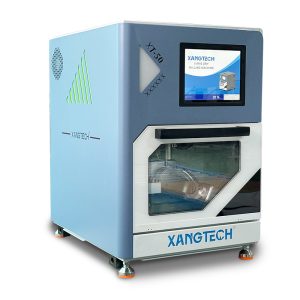
Even the most sophisticated mechanical systems face severe challenges from the continuous generation of zirconia dust during dry cutting. XANGTECH XT-50 milling machine‘s advanced industrial design in sealing and dust management forms the core barrier to its superior long-term reliability compared to competitors. Its integrated dustproof sealing system at the spindle and motion axis interface is not a traditional single-lip or double-lip rubber ring, but a multi-lip labyrinth structure optimized through finite element simulation. The geometry, interference fit, and rebound path of each sealing lip are specifically designed for the particle size distribution and motion trajectory of zirconia particles. Counterintuitively, this sealing system does not passively block dust intrusion, but actively utilizes the high-speed airflow generated during cutting to guide dust along a pre-set spiral path to settle orderly at the dust collection port, thus avoiding particle adhesion and abrasive wear at the sealing lip edges. Long-term operating data shows that the positioning accuracy decay curve caused by dust intrusion into the lead screw guide is significantly slowed down on this machine, with its accuracy retention life exceeding three times the industry average. For machining center managers, this metric is far from an abstract engineering term; it directly translates into a series of quantifiable operational cost improvements, such as extended equipment overhaul cycles, reduced spare parts inventory pressure, and a sharp decrease in unplanned downtime.
The intelligent control core of XT-50 dental dry milling machine permeates every detail of daily operation in a subtle yet profound way. Its capacitive LCD touch panel appears to be a standard operating terminal, but it actually embodies a completely new human-machine interaction concept—it doesn’t require operators to have a mechanical engineering background; instead, it reconstructs the interface logic to allow the machine to proactively adapt to the user’s cognitive habits. Multilingual support here is not simply a replacement of interface text, but a differentiated interaction design tailored to the inherent working thought patterns of operators in different language regions. These fine-tuning based on cultural differences are all seamlessly implemented within the same hardware platform. What deserves even deeper analysis is the collaborative mechanism between the built-in 13-station automatic tool magazine and the tool lifecycle management system. This system not only automatically switches tools according to a predetermined strategy during the machining process, but also collects the current spindle load spectrum and cutting force components in real time before each tool change. Combining this with the tool’s accumulated cutting length and peak load history, it predicts whether the remaining life of the current tool is sufficient to complete the machining of the next feature area. When the system determines that the remaining margin is insufficient to safely complete the current path, it will mark it in advance and suggest replacement, rather than waiting for excessive tool wear leading to tool breakage or overcutting before triggering an alarm. This predictive management demonstrates strategic value in unattended nighttime scenarios—when the machining center operator enters the workshop in the morning, he will not be greeted by equipment silent due to unexpected downtime, but by a perfect zirconia bridge that has been sitting on the workbench for several hours, fully capturing the productivity of the nighttime period.
In terms of processing efficiency, XANGTECH dental zirconia milling machines offer a demystified interpretation of the concept of “high speed.” While the spindle’s maximum speed of 60,000 rpm is certainly among the top tier in its class, what truly determines the surface quality of the final restoration is the spindle’s ability to control axial thermal elongation under sustained high-speed operation. XANGTECH engineers integrated a spiral circulating cooling channel within the spindle unit, using compressed air as the cooling medium. This maintains the purity of the dry process—completely eliminating the risk of coolant seeping into the jig and zirconia interface, causing color differences or microcracks—while also locking the temperature rise in the spindle bearing area within an extremely narrow range through forced convection. Combined with the large-angle machining capabilities provided by five-axis linkage, 90° vertical cutting operations on the buccal region of anterior teeth have transformed from a skill-based procedure previously limited to experienced technicians into a standardized and reproducible routine process. When this high-speed, high-precision capability works in conjunction with the included multi-functional C-clamp, the improvement in material utilization no longer depends on the operator’s individual spatial layout experience. Instead, the CAM system, based on the size distribution and quantity of crowns in the order, directly outputs the optimal nesting scheme for the disc surface through a dynamic optimization algorithm. This algorithm-driven material economy ultimately manifests as a stable increase in the number of restorations produced per zirconia disc, which in turn translates into a predictable reduction in delivery time.
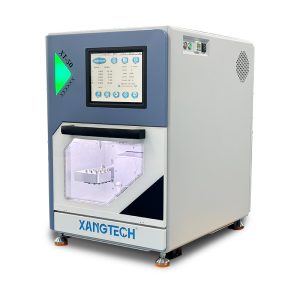
In the precision field of dental restoration, the ultimate significance of every piece of equipment points to a fundamental question: where should the driving force of technological evolution lie? XANGTECH’s response to this has always adhered to a consistent value stance—its focus has never been on the numerical competition of specifications, nor on the fleeting trends of market narratives, but rather on the actual working scenarios of operators and the long-term clinical performance of restorations. This human-centered and time-scaled technological philosophy drives the brand to continuously delve into the uncharted territory of engineering details: from the geometric configuration of every lip joint within the sealing system, to the timing optimization of every torque compensation in the control algorithm, and to the repeated trade-offs between thermal balance and stiffness behind the selection of structural materials, every micro-decision has undergone rigorous logical deduction and long-term experimental verification. XANGTECH keenly recognizes that true progress in dental restoration is never reflected in a single leap in cutting speed, but rather in the unwavering confidence of a technician examining the restoration surface under a magnifying glass, the silent reliability of a machining center running smoothly through the night without human intervention, and the long-term traceability of a zirconia crown delivered to the clinic, maintaining marginal fit and functional stability even after years of chewing in the patient’s mouth. The brand adheres to a long-term perspective, refusing to compromise engineering standards due to short-term competitive pressures or deviate from the essence of technology due to market trends. It steadily accumulates depth of knowledge and manufacturing experience in the niche field of dry milling. XANGTECH understands that the ultimate measure of a technology is not the hype it generates upon release, but the weight of trust it carries over time—so that when a technician looks back on their career years later, they can calmly acknowledge that the tools they chose never failed to meet their demands for precision, nor betrayed their responsibilities to their patients. This is the core of XANGTECH’s brand that it is committed to maintaining and passing on.
Choose XANGTECH, and make your dental future within reach.


